
 Most people are familiar with learning objectives in corporate training and talent development. They usually appear at the start of a course outline and often look like this:
- “Understand customer service.”
- “Learn about safety procedures.”
- “Know the procurement process.”
They’re meant to let participants know what the course is about. But not all learning objectives are created equal. For example, these three might look fine at first glance, yet despite being well intentioned, they’re useless if you want intentional, precise training. That’s because they offer little concrete information to the learner, the trainer, or the business. They’re vague, unmeasurable, and impossible to observe. They don’t tell you what someone will actually be able to do when they get back to work.
Why Use Learning Objectives?
Learning objectives used in corporate training and talent development should be the opposite of vague. They should be practical, specific, and tied directly to workplace performance. When written well, they:
- guide instructional design to ensure training is aligned with organizational objectives and learning activities are both intentional and precise
- Provide facilitators with clarity to pivot and respond to learner needs to ensure optimum learning experiences
- set clear expectations for all stakeholders, including the folks who fund it and the participants who attend
- support coaching and feedback so that it consistently leads to performance improvement
- give managers confidence that they can trust sending their staff to training
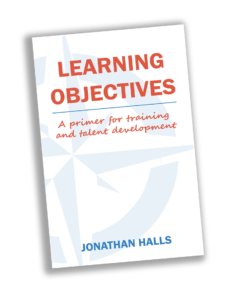
A lot of learning objectives used in training around the globe fail to deliver this precision and more often than this is because they are vague. In this article, we’ll explore what learning objectives are and discuss some ways you can write them. These insights are drawn from my recent book, Learning Objectives: A Primer for Talent Development Professionals.
I believe that robust learning objectives are foundational to effective training and talent development. When we use them well, they transform performance which can extend well beyond their traditional use in the classroom. They anchor what we do and equip us to deliver development in a more precise and intentional way. And they help us talk the language of our stakeholders, which builds credibility.
It’s for this reason I wrote my latest book. If I could, I’d give away free copies but paper costs money so that’s not an option. However, I’m pleased to say that I have been able to get the Kindle version of my book made available at cost, for just a few dollars. Yes, by all means grab a copy of the print edition. But for less than a coffee, you can download the Kindle copy. My goal is simple: help as many talent professionals as possible write clearer objectives, deliver better learning, and build the credibility of our work with stakeholders.
What Exactly Is a Learning Objective?
A learning objective is a clear, concise statement describing what a learner will be able to do after a learning experience. It’s not about what the trainer will cover. It’s not about what the learner will “understand.” It’s about observable performance.
A strong learning objective answers three questions:
- What will the learner do? (Action)
- Under what conditions will they do it? (Condition)
- How well must they do it? (Standard)
This structure, based on the work of Robert Mager, shifts objectives from vague intentions (“improve communication skills”) to observable performance (“conduct a performance feedback conversation using the company’s three-step model”).
The three elements work together:
- Action describes the task.
- Condition describes the context.
- Standard describes the level of performance.
Once you understand this structure, writing strong objectives becomes much easier — and your training becomes more effective.
The Action Element: What Will the Learner Do?
The action element is the backbone of the learning objective. It describes the specific, observable task a learner must perform. It is anchored on an action verb.
Good action verbs include:
- write
- analyze
- assemble
- troubleshoot
- de‑escalate
- facilitate
- calculate
- configure
These verbs describe performance you can see. So, avoid non‑action verbs such as:
- understand
- know
- appreciate
- learn
- be aware of
These describe internal states, not observable behavior.
For example:
- Instead of “Understand the procurement process…”
Use “Submit a procurement request…” - Instead of “Learn about conflict resolution…”
Use “De‑escalate conflict…”
Clear action verbs make objectives concrete and assessable.
 The Condition Element: Under What Circumstances Will the Task Be Performed?
The condition element describes the context in which the learner will perform the task. This matters because the same task can look very different depending on the environment.
Take the example of deescalating conflict. Let’s say we’re training youth workers to deescalate conflict among young people they are caring for. They may need to deescalate conflict:
- in a quiet counseling room
- in a busy community center
- during street outreach
- when surrounded by other youth who are taking sides
- when working alone
The action is the same, but the conditions change everything — the risks, the required knowledge, and the strategies.
Conditions often describe:
- Location: call center, kitchen, aircraft, community center
- Tools: Excel, CRM, radio, stethoscope
- Circumstances: high volume, safety risk, system outage
- Timing: after a triggering event, before takeoff, during peak hours
You do not need to list every condition; just the one that defines the real-world context.
Examples:
- Handle customer complaints (action) over the phone during a system outage (condition).
- Facilitate a virtual meeting (action) using WebEx (condition).
Clear conditions help designers create relevant activities, help trainers make informed decisions, and help learners know exactly what they will be learning.
The Standard Element: How Well Must the Task Be Performed?
The standard element defines how well the learner must perform the task. Without it, “good” becomes subjective, and performance varies from trainer to trainer.
The standard makes expectations concrete and consistent.
Standards may be:
- Time‑based: “Complete within 10 minutes…”
- Quantitative: “Guide up to 8 participants…”
- Accuracy‑based: “Follow the safety checklist…”
- Criteria‑based: “Demonstrate empathy using the STATE model…”
- Model‑based: “Apply multimedia learning principles…”
Examples:
- Change a tire (action) on the roadside (condition) following the Audi safety manual steps (standard).
- Create a project budget (action) in Excel (condition) with zero formula errors (standard).
- Facilitate a discussion (action) in an adult learning environment (condition) using the FOID technique (standard).
Including the standard element allows:
- consistent assessment across trainers
- learners to know what “good” looks like
- managers to trust what staff can do after training
- organizations to build capability frameworks
Task Complexity and Bloom’s Taxonomy
Some tasks are more complex than others, and choosing the right verb helps reflect that. Bloom’s Taxonomy is a common reference point for describing task complexity.
Bloom’s classifies learning into three domains:
- Cognitive (thinking)
- Psychomotor (physical skills)
- Affective (mindset)
It also organizes tasks from simple to complex. In the cognitive domain, for example:
remember → understand → apply → analyze → evaluate → create
A candid note
Because people widely reference Bloom’s, it is important to understand the basics. But I rarely recommend using it as a design tool in corporate learning. Some parts are solid, others are debatable, and the system can become cumbersome in fast-moving environments. Still, because it’s so common, it’s worth knowing how it works. This might make me sound like a heretic to learning geeks, so I address this in my latest book on learning objectives where I list just a few of my reasons. But for most people, I won’t bore them here.
Why Bloom’s matters
Many instructional designers use Bloom’s to:
- choose verbs that reflect task complexity
- sequence learning from simple to advanced
- distinguish foundational tasks from higher‑order ones
Putting It All Together: A Complete Learning Objective
A complete learning objective includes:
Action + Condition + Standard
Examples:
- De‑escalate conflict with a young person (action) in a busy community center (condition) using the organization’s three-step model (standard).
- Create a project budget (action) in Excel using the company’s Budget Template v4.2 (condition) with zero formula errors (standard).
- Facilitate a virtual meeting (action) using WebEx (condition) following the FOID questioning technique (standard).
- Change a wheel on a Formula 1 car (action) in the pit during the race (condition) in 19 seconds (standard).
A lot of trainers find the process of writing learning objectives to be fiddly at best, and an act of mental gymnastics at worst. The good news is that with practice they becomes quicker and easier to write and after a while they become intuitive. One way to write them fast is adopt the Know Mindset which starts with asking, what does the learner need to do, rather than what does the learner need to know?
Why Learning Objectives Fail (and How to Avoid It)
After over thirty years teaching trainers how to write learning objectives, I see the same mistakes repeatedly:
- Using vague verbs
“Understand,” “know,” and “learn” don’t describe performance. - Describing teaching methods instead of workplace conditions
“Given a case study…” is not a workplace condition. - Leaving out the standard
Without a standard, performance becomes subjective. - Writing objectives that are too broad
“Improve communication skills” is not an objective. - Writing objectives that are too narrow
“List three benefits of X” rarely reflects real‑world performance.
The fix
Use the three‑element structure.
Keep it practical.
Focus on workplace performance.
Learning Objectives
Clear learning objectives sit at the heart of effective training. They sharpen our focus, strengthen our credibility, and help us design development solutions that genuinely improves performance. They’re worth the extra time and effort to write them well.






Comments are closed.