

Learning objectives can sound polished yet still fail to tell stakeholders what participants will actually be able to do after the learning. In this skills briefing, Jonathan Halls explains why the action element matters and how a clear, observable verb sharpens design, facilitation, and performance conversations.
Writing the Action Element in Learning Objectives
A few weeks ago, I was browsing the catalogue of a well‑known seminar company and came across a communication course with this learning objective: “Know what makes effective, powerful communication and develop the skills to model it.” It’s a bold promise — but would you send your staff to a course based on that statement?
I’m not sure I would. It’s vague, abstract, and gives no clear sense of what participants will actually be able to do afterward.
In training and talent development, learning objectives describe the workplace tasks that learners will be able to perform after a learning experience. They aren’t lofty goals but specific descriptions that tell everyone — from trainer to learner, instructional designer to the supervisor who sends people on the course — what the outcome will be.
Effective learning objectives have three elements: the action, condition, and standard. The action element describes what needs to be done, the condition element sets out any special circumstances under which it is performed, and the standard element describes the external criteria the trainer should use for feedback and assessment. Of these, the action element is arguably the most important because it describes the task itself. Without a clear action, the condition and standard have nothing to anchor to.
So it’s important to write them well.
Action Verbs Are the Heart of the Action Element
The action element begins with an action verb — a dynamic verb that describes something we can see, hear, touch, smell, or taste. Examples include:
- brew
- analyze
- drill
- design
- describe
- facilitate
- submit
These verbs describe observable actions. It is poor practice to use non‑action verbs like understand, know, appreciate, and realize because they describe internal states or mental processes that we cannot directly observe. Consider the statement, “Realize the benefits of planning for meetings”. This was listed in a seminar about running meetings and tells us nothing about what the learner will actually be able to do at the end of the class. Realize could mean five different things to five different people.
 Avoid Knowledge Statements
It’s easy to fall into the trap of writing knowledge statements when framing the action element. This happens because most of our learning experiences — from kindergarten through college — have been content‑driven. We were tested on whether we understood the theory of relativity or remembered who Napoleon was. But workplace learning is about task mastery, not content coverage.
A graphic design trainer in one of my classes once framed an objective as “Know different graphics file formats.” She was adamant that she needed the word know and argued passionately to keep it in. Knowledge is important, of course, but we cannot see knowledge, which makes it impossible to assess or evaluate and provide feedback on it. So, I asked her why learners needed to know image file formats. She answered, “So they export images in the correct file format for the project.” Her answer described the task — and became the action element. Her objective became, Determine the correct file format for the image …”
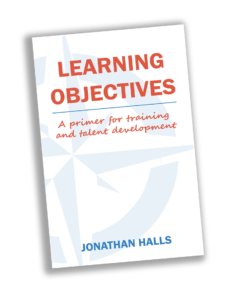
I often see people writing action statements who fall back into the Knowledge Mindset in which they write statements like “understand the difference of …” or “appreciate the levels of…” We can’t see or assess understanding or appreciation — we can only assess what people use them for. One way around this is to adopt the Do Mindset, which I describe in my recent book on learning objectives for talent professionals. The Do Mindset helps us think about training through the language of performance.
Be Specific and Concrete
Specific, concrete language makes learning objectives meaningful. Vague phrases like “take your leadership to the next level” or “cultivate excellence” sound appealing in marketing copy but are useless when designing or assessing performance. What is “the next level”? What does “excellence” mean? Without specificity, supervisors cannot trust what their staff will gain from the course.
Write Single‑Purpose Action Elements
A common mistake newbies make is to cram more than one action into a single objective. If an objective contains more than one verb, it’s actually multiple objectives in one. For example:
- “Select and use data collection techniques…”
“Selecting” a data technique is one task, while “using” it is another. Each draws on different knowledge, skills, and mindsets, so it’s cleaner to separate them.
Position the Action Element First
When you write a learning objective, it doesn’t really matter whether you put the action element first, second, or third. But to make it more accessible and easier to read, it’s best to start with the action element. For example:
“Brew an espresso coffee (action) at Acme Café with the Rancilio Classe 5 Espresso machine (condition) following the Acme Secret Recipe (standard).”
It used to be common for folks to start with a subordinate clause, but this goes against Plain Language conventions and makes the statement more cumbersome. For example:
“Given the Rancilio Classe 5 Espresso machine at Acme Coffee Shop (condition), brew an espresso coffee (action) following the Acme Secret Recipe (standard).
Tips for Writing Strong Action Elements
- Ask what action the learner must take to complete the task.
- Shift from a know mindset to a do mindset.
- Choose verbs intentionally, not from a random list.
- Use specific, concrete language.
- Avoid abstract or buzzword‑heavy phrasing.
- Ensure there is only one verb — one task per objective.
Unhelpful Verbs
Avoid verbs that describe internal states or vague intentions, such as:
- appreciate
- be aware of
- realize
- gain an understanding of
- familiarize yourself with
These cannot be observed or assessed.
The Bottom Line
The action element is the foundation of a strong learning objective. When you choose a precise, observable verb and describe a single, concrete task, you set the stage for clearer design, stronger facilitation, and more credible outcomes.







Comments are closed.