

Organizations do not invest in learning for learning’s sake.
They invest because they need people to perform, adapt, innovate, solve problems, and contribute to meaningful organizational outcomes. Yet despite decades of research into learning and development, many workplace learning initiatives still struggle to produce lasting capability.
The problem is not a lack of research. It is that the research often exists in separate disciplines. For example, cognitive psychology explains how people learn. Organizational development explains how culture influences behavior. Human resource development explores performance and growth. Leadership research examines coaching and feedback.
Each perspective offers valuable insights. The challenge is bringing them together in a way that helps people build capability in real organizations.
That challenge led to the development of the Capability Architecture Model (CAM). Developed by Jonathan Halls, the Capability Architecture Model emerged from more than thirty years of professional practice in workplace learning, coaching, leadership development, and human resource development, combined with ongoing engagement with scholarly research and work supporting learning initiatives across more than twenty-five countries. CAM does not seek to replace existing theories. Rather, it provides a framework for integrating them into a coherent approach to capability development.
At Jonathan Halls LLC, CAM serves as the primary framework through which we approach talent development, workplace learning, leadership growth, and performance improvement.
The Challenge with Most Workplace Learning
Many talent development initiatives focus heavily on one aspect of learning while overlooking others.
Some programs are carefully designed but ignore the conditions under which learning occurs. Employees are expected to learn while overwhelmed, exhausted, or operating in cultures that discourage experimentation and feedback.
Many other programs, however, prioritize engagement and the pursuit of “fun” learning experiences but lack instructional rigor. Participants leave feeling inspired but struggle to apply what they learned on the job.
Still others provide effective training experiences but never clearly define the capability that should emerge from the effort or how it connects to organizational priorities.
In each case, something important is missing.
Capability Emerges at the Intersection of Three Dimensions
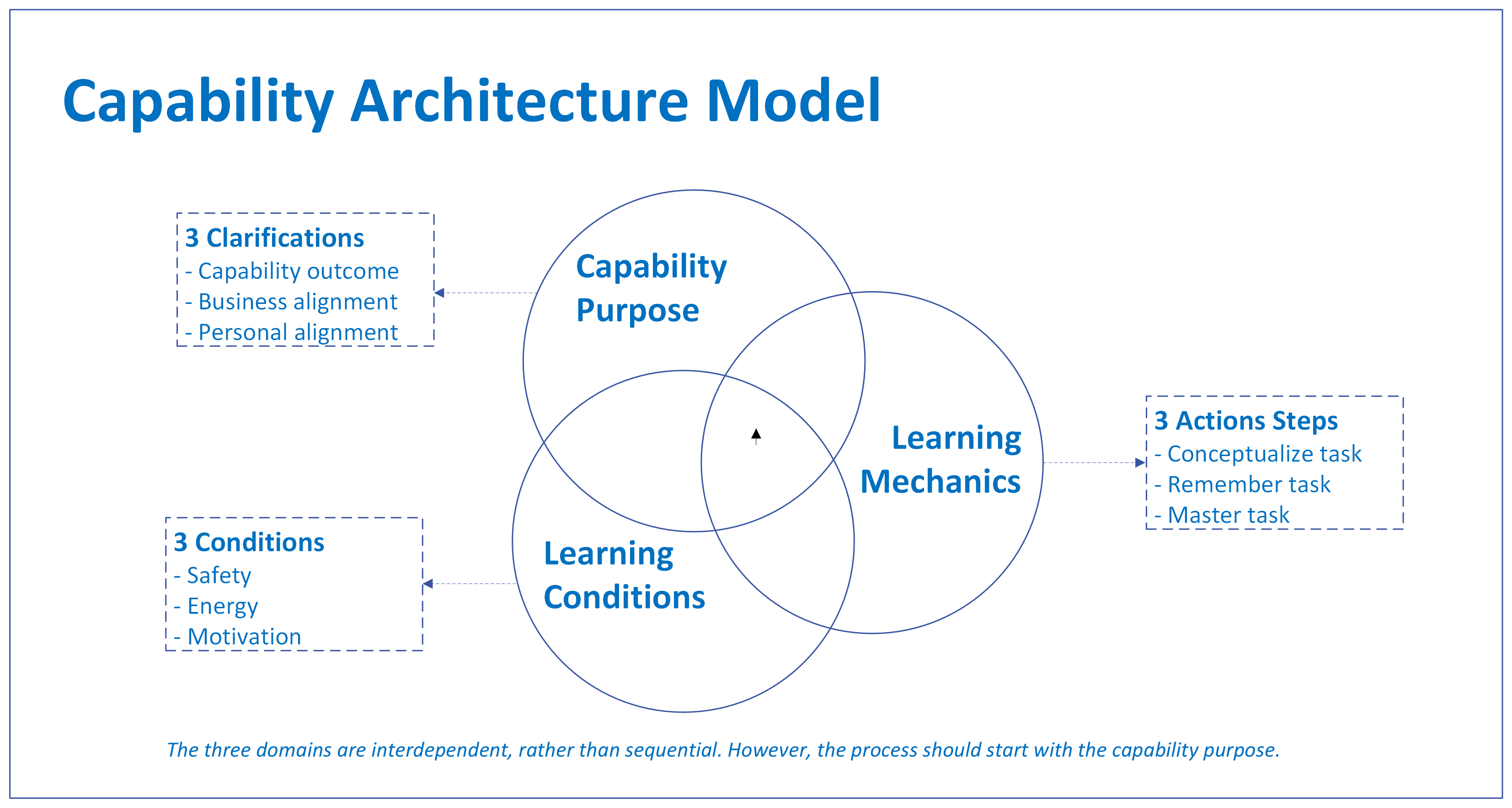
The Capability Architecture Model is built on the assumption that workplace capability is built at the intersection of three dimensions: purpose, mechanics, and conditions. That’s because:
- workplace learning must have a clear purpose. Organizations invest in learning with the expectation that it improves performance supporting strategic goals.
- learning is an active cognitive process that follows certain mechanics. People must build understanding, retention, and apply the learning successfully on the job.
- the conditions surrounding learning influence the success of learning. Factors like psychological safety, motivation, and workload, affect learners’ ability to engage.
These assumptions form what we call the capability formula:
Capability Development = Purpose × Mechanics × Conditions
The multiplication symbol is intentional. If any dimension is weak or neglected, the overall impact of capability development is diminished.
Capability development is not solely a learning concern. It is also a performance concern, a leadership concern, and often a workplace culture concern.
The Purpose Dimension
The Purpose Dimension provides the foundation for all capability development efforts by ensuring the performance objective is clearly articulated.
Before designing a training program, assigning developmental experiences, or beginning coaching conversations, a clear outcome must be established. CAM frames capability as the ability to perform meaningful actions that support both organizational priorities and individual aspirations.
This dimension draws from the logic of criterion-referenced objectives, particularly the work of Robert Mager (1997), emphasizing that successful development efforts should define what learners will be capable of doing following the learning experience.
Purpose matters for several reasons.
Organizations need confidence that learning investments support strategic priorities and tactical actions to apply those strategies.
Having a clear purpose provides greater clarity for learning experience design, performance feedback, talent management, and learner self-reflection.
Workforce engagement also tends to improve when employees can see a clear connection between development goals, career aspirations, and organizational strategy.
The Learning Mechanics Dimension
The learning mechanics dimension considers what learners must practically do to learn a new task.
This dimension draws heavily from cognitive psychology information-processing research including the foundational work of Atkinson and Shiffrin (1968), while incorporating Baddeley and Hitch’s (1974) model of working memory. It uses Schema Theory (Anderson, 1977; Rumelhart, 1980) to make sense of how memories are formed and used. Retrieval practice for building retention (Roediger & Karpicke, 2006). And performance improvement research to look at how learning can be used to develop mastery (Ericsson et al., 1993; Hattie & Timperley, 2007).
CAM breaks the learning process into three specific steps. Understanding, retention, and mastery. We often refer to the learning formula, featured in Jonathan Halls’ book, Confessions of a Corporate Trainer (Halls, 2019) which is U+R=M=L.
People first need to understand what they are learning. Then remember it. Then master it on the job.
The Learning Conditions Dimension
The Learning Conditions Dimension ensures the conditions are right for the learning to happen. This involves considering the learner’s personal state, the culture in which learning occurs and the physical environment.
CAM considers important dynamics for learning such as psychological safety, motivation, and personal capacity. (Edmondson, 1999) to ensure learners feel safe to ask questions, seek feedback, and learn from mistakes. It highlights the role of culture and its impact on learning, drawing on Schein’s (2021) understanding of organizational culture and considers environmental factors like resources, the temperature in which learning occurs, physical distractions, and similar environmental factors.
From Trainer to Capability Architect
One of the distinctive features of CAM is its view of capability development as a collaborative process. Rather than viewing development as something done to learners by trainers, CAM emphasizes co-design between two participants.
The architect facilitates the process. Depending on the context, this may be a trainer, manager, coach, teacher, mentor, or leader.
The builder is the person developing capability. In a corporate training class, this is the participant. In a manager-employee relationship, it is the employee.
This language reflects the model’s constructivist orientation. We don’t see capability as a copy and paste exercise where knowledge or skills are transferred from one person to another. We see it as built through intentional learning experiences, thoughtful guidance, reflection, experimentation, feedback, and practice.
The role of the architect is not to provide all the answers. It is to help create the conditions under which capability can emerge.
Research-Informed, Practice-Tested
The Capability Architecture Model is not a new learning theory. It is a framework of practice. It synthesizes insights from cognitive psychology, adult learning, human resource development, performance improvement, organizational culture, coaching, and leadership development into a practical architecture for capability development.
Equally important, it has evolved through decades of real-world application. The ideas underpinning the model have informed our training programs, coaching engagements, leadership-development initiatives, and performance-improvement, and consulting efforts across multiple industries and regions of the world.
CAM represents an ongoing effort to bridge two communities that are often disconnected: scholars seeking to understand learning and practitioners seeking to improve performance.
Why CAM Matters Now
Organizations today face relentless pressure to adapt.
Skills become outdated faster than ever. Managers are increasingly expected to act as coaches and developers of talent. Learning budgets are scrutinized carefully. At the same time, organizations need employees who can continuously expand their capabilities rather than simply repeat yesterday’s performance.
This reality requires a broader approach to development. The Capability Architecture Model provides that approach. Instead of focusing exclusively on content, engagement, culture, performance, or learning theory, CAM integrates all of these considerations into a single framework for intentional capability development.
It asks three deceptively simple questions:
- What capability are we trying to build?
- How can we build it?
- What conditions do we need to create to support building that capability?
The questions are straightforward. The research behind them is substantial. CAM exists to help leaders, managers, trainers, coaches, and learners translate that research into practical action and meaningful capability development.
Selected Research Foundations
The Capability Architecture Model synthesizes insights from multiple disciplines. Key influences include:
- Anderson (1977) – Schema activation and learning
- Atkinson & Shiffrin (1968) – Information processing theory
- Baddeley & Hitch (1974) – Working memory
- Edmondson (1999) – Psychological safety
- Ericsson, Krampe, & Tesch-Römer (1993) – Deliberate practice
- Hattie & Timperley (2007) – Feedback and performance improvement
- Mager (1997) – Criterion-referenced objectives
- Roediger & Karpicke (2006) – Retrieval practice
- Rumelhart (1980) – Schema theory
- Schein & Schein (2021) – Organizational culture and leadership